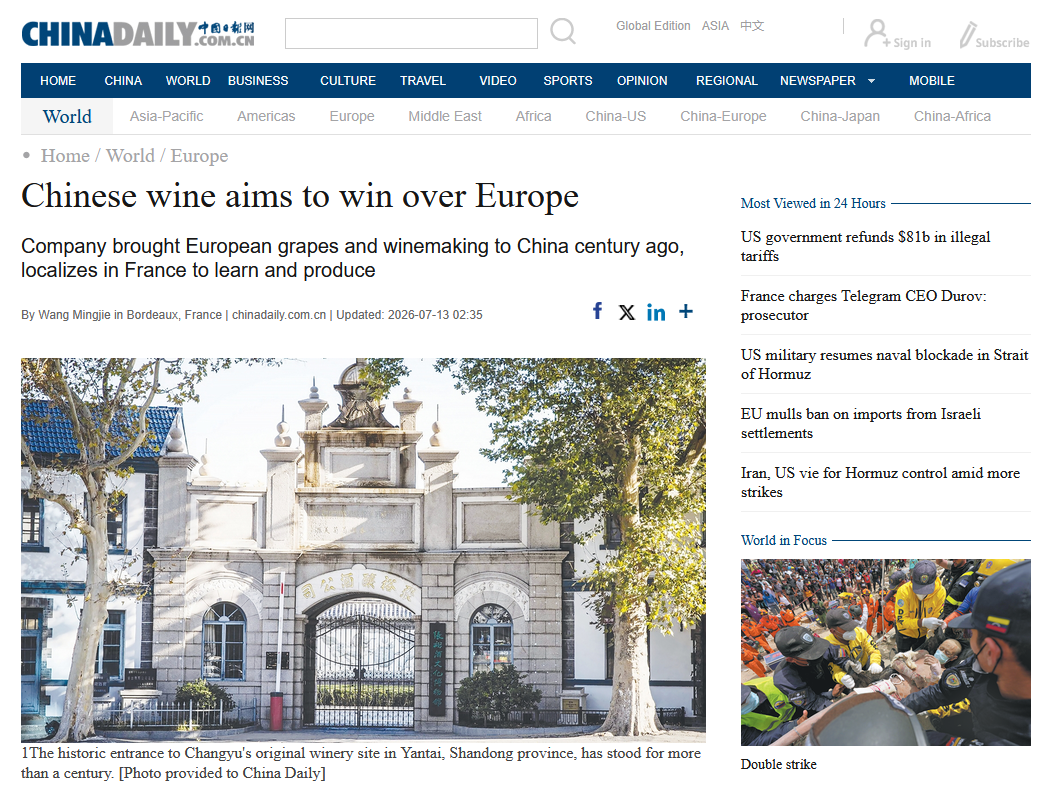
1The historic entrance to Changyu's original winery site in Yantai, Shandong province, has stood for more than a century. [Photo provided to China Daily]
For many European consumers, China is rarely associated with wine in the same way as France, Italy or Spain. Yet over the past decade, Chinese wine producers have been making increasing efforts to gain recognition in international markets.
Among them is Changyu, founded in 1892 in Yantai, Shandong province, and widely regarded as a pioneer of China's modern wine industry. Established during the late Qing Dynasty (1644-1911) by overseas Chinese businessman Zhang Bishi, the company introduced European grape varieties and winemaking techniques to China at a time when modern industrial wine production in the country was still at an early stage.
Today, Changyu is one of China's largest wine producers. In recent years, however, the company has shifted part of its focus toward international expansion, particularly in Europe.
According to Sun Jian, general manager of Changyu, the company's overseas strategy began in 2013 after years of growth in the domestic market.
"At that time, we had already accumulated enough strength in the domestic market," Sun said. "We had built sufficient competitiveness and market position in China."
He said the move abroad was driven by long-term ambition rather than domestic market pressures.
"It was time for us to go global," he said, adding that Changyu hoped to transform itself "from China's Changyu into the world's Changyu".
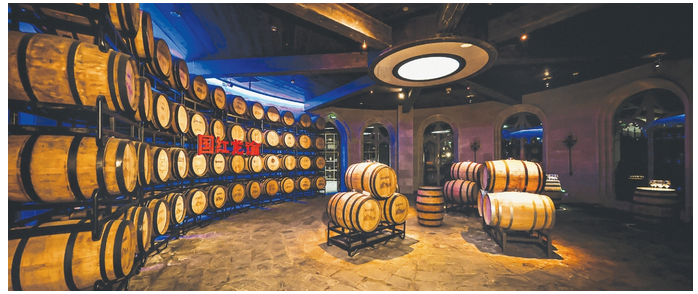
2The wine cellar at Chateau Changyu Longyu in Ningxia Hui autonomous region, one of the company’s flagship wineries in China.
Seeding growth in Bordeaux
Changyu's expansion into France reflects a broader trend among some Chinese companies seeking to deepen ties with established European industries through acquisitions and partnerships.
For Changyu, Bordeaux offered not only prestigious wine assets but also access to centuries of winemaking expertise, global distribution networks and international branding experience.
"At Changyu, working alongside giants allows us to learn much more," Sun said.
The company's presence in Bordeaux has developed gradually over the past decade. In 2015, the company acquired a 90 percent stake in Chateau Mirefleurs from the Castel Group, marking one of its early moves into the French wine industry.
In 2019, Changyu and French wine company Advini jointly established L&M Holdings, a venture responsible for managing Chateau Mirefleurs and another Changyu-owned Bordeaux estate, Chateau Liversan.
Under the arrangement, operations in France are jointly managed by the two sides, while branding and market operations in China are handled by Changyu Pioneer Wine Company, a wholly owned subsidiary of Changyu.
The structure reflects Changyu's evolving approach to operating in Europe. Rather than relying primarily on direct management from China, the company has increasingly emphasized localized cooperation and shared management with experienced French partners.
But operating in Europe also brought challenges beyond winemaking itself.
Sun said the company initially faced issues including cultural differences, management structures and integrating local operations after acquiring French wineries.
"At first, we sent management teams from China," he said. "Later we realized this approach did not adapt well to local conditions."
Changyu then moved toward hiring local managers, but the company eventually concluded that long-term cooperation required a more balanced structure.
"A better solution was to work with management teams or partners who shared our values and management standards," Sun said.
The company also adjusted its ownership model to align long-term interests between Chinese and French partners. One example is Changyu's partnership with Advini, France's only publicly listed wine company. Under the arrangement, Changyu holds a 55 percent stake while Advini owns 45 percent.
Robin Jeudy, winemaker at Chateau Mirefleurs, said the partnership allows both sides to contribute different strengths.
"Advini has the knowledge in the wine industry for a long time, so they can bring the expertise of winemaking here," Jeudy said. "Changyu also is a very old company in wine producing. They have very good knowledge about winemaking, and they know the market in China very well."
Jeudy said cultural differences between Chinese and French teams are evident in day-to-day operations, but can also complement each other.
"Chinese people always have a lot of ideas, and they want to go fast," he said. "French people take time to make decisions. Combining both parts, we go further together."
Industry analysts say this balancing act between localization and maintaining Chinese ownership objectives is a common challenge for Chinese companies operating overseas, particularly in industries closely linked to culture and tradition, such as wine.
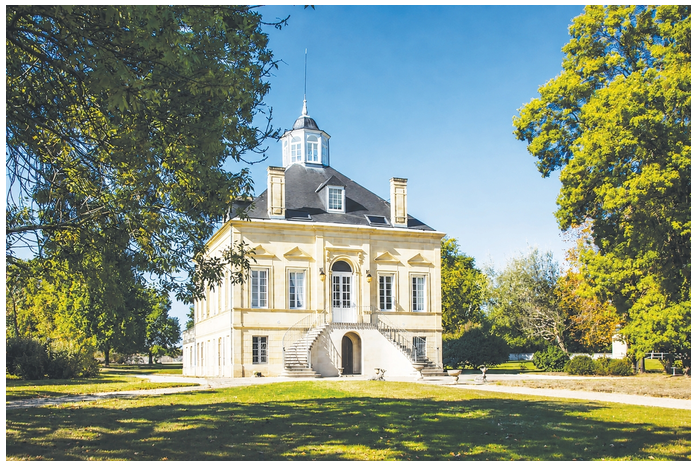
3Chateau Mirefleurs in Bordeaux, France, is part of a joint venture between Changyu and French wine company Advini. [Photo provided to China Daily]
Through the grapevine
Although China has become one of the world's largest wine-consuming countries over the past two decades, China's own wine production has yet to catch up with the same-level of influence in international recognition.
Over the past two decades, wine production in regions such as Ningxia, Xinjiang and Shandong has expanded rapidly, while some Chinese wineries have gained attention at international competitions. However, awareness among European consumers and professionals remains limited.
Sun said perceptions are gradually beginning to change.
In February of this year, Changyu participated in Wine Paris, one of Europe's largest wine exhibitions. During the event, French President Emmanuel Macron visited the company's exhibition space.
Sun later referred to comments Macron made during an AFP interview, in which the French president said China was capable of producing fine wines and warned French producers to pay attention to competition from countries including China and Italy.
"I think those remarks represent strong recognition of Chinese wine," Sun said.
For industry observers, however, one of the biggest barriers facing Chinese wine internationally is
still a lack of understanding rather than quality itself.
Fan Lina, a wine and spirits expert and founder of the Paris International Wine and Spirits Experience Center, said many European consumers simply have little exposure to Chinese wine regions or styles.
"There is still a major knowledge gap internationally when it comes to Chinese wine," Fan said, adding Chinese wine remains largely absent from international wine education systems and professional training programs.
"As for professional education and training, Chinese wine regions remain almost blank within the international system," she said.
According to Fan, this lack of familiarity can sometimes lead Chinese producers to misread the European market.
"Some Chinese producers believe Europeans do not like Chinese wine," she said. "But in many cases, people simply have never had the opportunity to understand or taste it."
Fan said many European wine consumers are surprised when introduced to Chinese wines for the first time.
"We have met many wine lovers who are surprised when they taste Changyu wines and say, 'China can produce such good wine?'" she said.
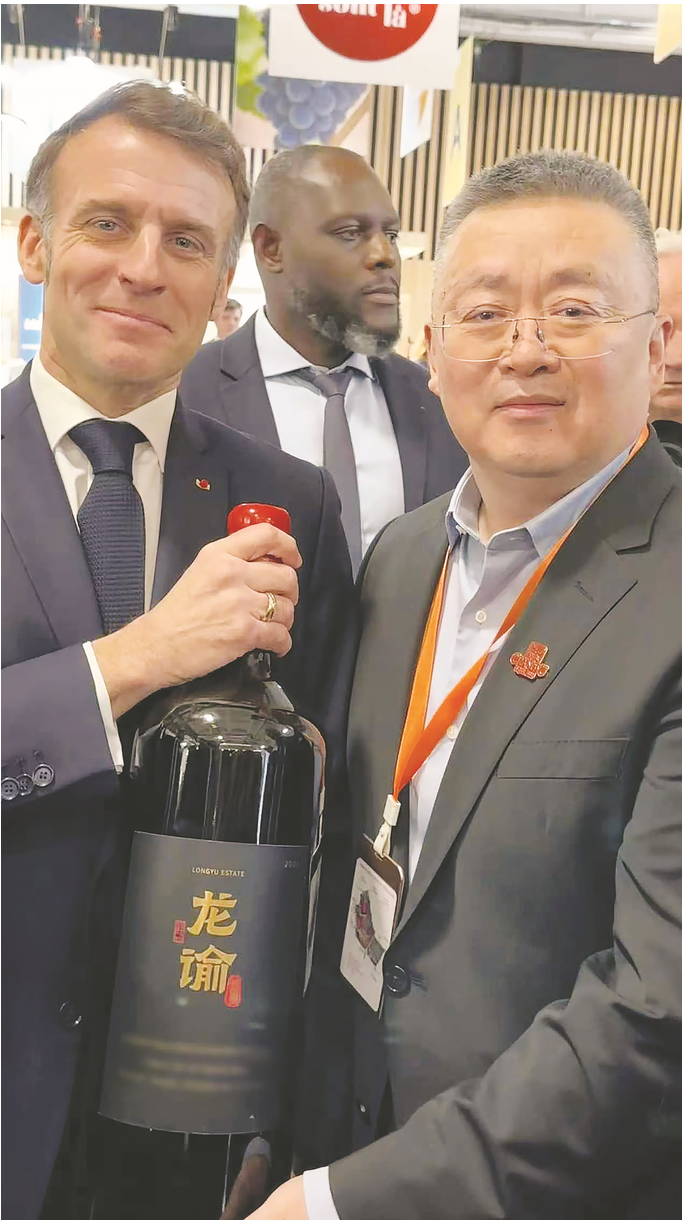
4Sun Jian (right), general manager of Changyu, presents a bottle of Chinese wine to French President Emmanuel Macron during Wine Paris trade show in February. [Photo provided to China Daily]
Presence in Paris
In February, Changyu opened the Changyu 1892 Art Gallery in Paris, which the company describes as an international experience center for Chinese wine culture.
The center hosts tastings, exhibitions and educational activities aimed at introducing Chinese wine to French consumers and industry professionals.
Fan described the project as strategically important not only for Changyu, but also for the broader Chinese wine industry.
"The Changyu 1892 Art Gallery not only sets a benchmark for Chinese wine going global," she said. "It can also serve as a starting point for the entire Chinese wine industry in international knowledge promotion, cultural promotion and product experience."
According to Fan, education will be essential if Chinese wine producers hope to establish a stronger foothold in Europe.
"If Chinese wine truly wants to enter the European market, the first step is to become part of the international education system," she said.
That could involve introducing Chinese wine regions, terroirs and production methods into sommelier courses and hospitality training programs in Europe.
"In the future, French wine professionals and sommeliers should all have Chinese wine as part of their courses," Fan said.
At the same time, she believes greater visibility in restaurants and retail channels will also be necessary.
"The second step is to export to Europe as extensively as possible," she said.
Fan argued that Chinese wine needs to become part of everyday dining experiences rather than remaining a niche curiosity.
"The goal is for European consumers to encounter Chinese wine naturally in restaurants and daily life," she said.
"Only in this way can Chinese wine gradually find its own place in the European market."
Observers say Changyu's expansion reflects a broader trend among Chinese companies seeking to combine international partnerships with greater cultural outreach.
For Changyu, Europe is not simply an export destination, but also a place to learn from one of the world's most established wine traditions while introducing European consumers to a relatively unfamiliar wine-producing country.
Significant challenges remain. European wine markets are highly competitive, consumer loyalties are deeply rooted, and Chinese wines still lack widespread recognition.
Yet Changyu's investments in Bordeaux and its new platform in Paris suggest that Chinese producers are increasingly seeking participation in the global wine conversation not only through trade, but also through education, localization and cultural exchange.