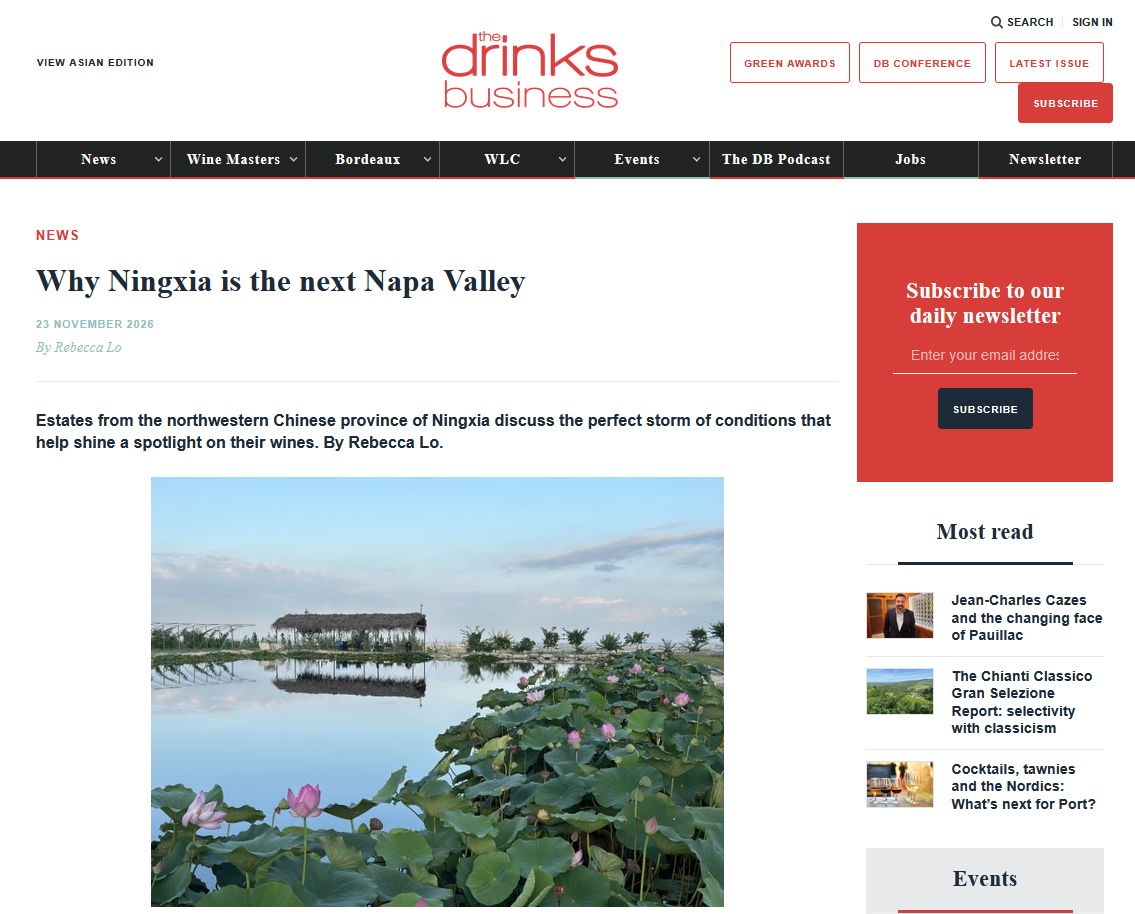
Devo Winery’s founder Zhai Liang wants to produce Asia’s best sparkling wine: a lofty ambition considering the winery’s first batch of bubbles was released in 2021.
Sited in the eastern foothills of Ningxia’s Helan Mountains, Devo was one of 20 Ningxia wineries present at ProWine Shanghai, held from 10 to 12 November at Shanghai New International Expo Centre. The autonomous region in northwestern China showcased its latest bottles at its Ningxia Helan Mountains Eastern Foothill Wine Region pavilion in hall W4.
Protected by the mountains, wineries on Ningxia’s eastern foothills benefit from a warm continental climate combined with alpine influences. They stretch north to south alongside the mountain range and enjoy more rain than the annual provincial average of 200mm.
Ningxia’s terroir is dominated by limestone and clay, with up to 40% of China’s silicon carbide used in quality ceramics hailing from the province. The province’s unique geology makes it ideal to cultivate many grape varietals for a various wine styles ranging from 12.5 to 13%ABV.
Solid standing
According to Xinhua, Ningxia is home to 130 operating wineries as of October 2026 that collectively produce 140 million bottles—equating to nearly 42% of China’s total wine output annually. Its promise led to it hosting the 47th World Congress of Vine and Wine and OIV General Assembly on 12 October 2026 in the provincial capital Yinchuan.
“Held for the first time in Asia, the congress in Ningxia signaled that Chinese wine has secured a solid standing internationally—and that our province is an outstanding representative of the country’s best wine region,” said Linda Wu with Fei Tswei Winery, one of the exhibitors at ProWine Shanghai.
She explained that nearly two decades ago, the Ningxia government developed a strategy to develop wineries including cultivating land and securing modern equipment.
“Other provinces are jealous at how much our government has invested,” Wu noted with a smile. “We now have so many wineries in the province that winery hopping is a little like driving through Napa Valley.”
With its first vines planted in 2013, Fei Tswei has experimented with 38 varieties and currently makes wine from 12 of the most suitable grapes for its terroir. Its predominantly limestone soil was initially littered with large stones. As the winery’s owner Lily Zhang is an avid global rock collector, stones became graphic symbols that grace Fei Tswei labels.
“Marselan does well on our 100 hectare estate, while Riesling not so good,” Wu said. Other Fei Tswei varieties include Merlot, Cabernet Sauvignon, Petit Verdot and Malbec, yielding up to one million bottles annually.
Its most popular brand is Lava, with an annual production of 150,000 bottles of Chardonnay that retails for CNY138 (₤15.70). Fei Tswei is currently exporting to countries including Japan, Malaysia, the UK and Germany, with further markets in southeast Asia being explored.
“We currently export around 15% of our production and hope to increase that by another 10 to 15% in the coming year or two,” Wu noted.
Fei Tswei estate
Gap in the market
For Zhai, winemaking followed a career building China’s infrastructure in second and third tier cities such as Xi’an and Yinchuan. As major construction projects in the country began winding down, the Ningxia native noticed a gap in his province’s wine scene.
“I love bubbles—especially high quality ones,” grinned Zhai.
Moët Hennessy Diageo China had started making sparkling wine in Ningxia on a site south of a winery for sale. Zhai bought it and transformed it into Devo, with its first harvest in 2018.
Similar to Fei Tswei, taking over the estate initially meant clearing stones. “These had to be removed before the land could be fully cultivated,” recalled Zhai. “The municipal government and different enterprises previously planted Cabernet Sauvignon and Merlot on our estate, which we removed. Now we only grow Pinot Noir and Meunier, and only make sparkling wines including rosé, which we produced in 2020 and 2024.”
With a total of 21 hectares, Devo has steadily increased production annually with a goal to reach 40,000 bottles by 2029. MV05, its fifth batch of multi-vintage sparkling, is a blend of 77% from the estate’s 2023 harvest and 23% reserve wine from 2018 to 2022 fruit. Aged for 24 months in oak barrels with zero dosage, it is equal parts Pinot Noir and Meunier, and retails for CNY400 (₤45.50).
Currently, Devo exports 20% of its production to key Asian markets including Japan and Singapore, alongside Mexico and Norway, with plans to break into the Australian market next.
“We see increased demand from younger Chinese drinkers, particularly ladies in the 25 to 35 age bracket with strong spending power,” noted Zhai. “We intend to address them by putting more efforts into increasing production and export, with an eventual target of exporting 50% of our bottles.”