DRINKS BUSINESS | Lap of luxury: what’s the future for fine wine in China?
Chinese caviar has captivated global palates, while foie gras from the country increasingly finds itself on restaurant menus, as China outpaces France as the world’s largest producer of the canard delicacy. In more ways than one, China has all its ducks in a row, rising rapidly like a mighty fire horse as a powerhouse consumer and creator of luxury goods. Its wine is no exception. Flashback 20 years: Chinese winemaking boiled down to bulk-made, heavy-handed reds, while France commanded from its fine wine throne.
Today, however, China is building a fine wine reputation of its own. With LVMH planting at 2,600 metres in Yunnan, and Ningxia family estates beating Bordeaux in international competitions, winemakers across China are redefining what it means to make luxury wine. The movement is politically backed too. After visiting Ningxia in 2020, President Xi Jinping pledged that the country’s wine would soon become “a marvel of the world”. But to win the world, you must first woo your home nation. To do so, Chinese producers aren’t simply borrowing the language of European luxury, but are, according to Anabelle Hourriez, chief growth officer at Shanghai-based branding agency Labbrand, “reinterpreting codes altogether – turning the bottle into a platform to celebrate China’s heritage, art and history”, in order to capture the interest of young, affluent consumers. 国潮Guochao (‘China Chic’) is no longer a fad, but a proud selling point, as
Bordeaux’s magic spell wears off. Once upon a time, Shaun Rein, founder of the China Market Research Group and author of The End of Cheap China, supped with Chinese billionaires who’d opt for whatever the most expensive French red on the list was, regardless of quality. But today, “when you go to a banquet, serving a Chinese rather than French wine is considered cool and patriotic, showing support for the country, especially during a tough time geopolitically”, he explains. Hourriez makes no bones about it: “Consumers are no longer won over by French heritage.” As Chinese wine imports weaken, falling by 10.6% in the first quarter of 2026, according to customs data, opportunities open for Chinese wineries crafting a new definition of luxury wine.
Defining luxury in China
While high-end Western wine relies on centuries-old tradition, China’s relationship with the category is far younger. “That changes what luxury means,” explains Hourriez. “Alongside the traditional connoisseurs seeking authenticity and expertise, we’re seeing a distinctly Chinese consumer group emerge – cultural explorers, often first adopters, drawn as much to novelty and a story to tell as to the wine itself. That appetite for discovery is arguably sharper in China precisely because there’s no multi-generational wine culture to conform to.”
This is echoed by Steven Gao, business director at Shanghai-based brand consultancy Landor. “Today, consumers are increasingly looking for brands with a story that belongs to China, rather than one borrowed from elsewhere,” he contends. This starts with appearances. When served at a professional dinner, the theatrical bottle-pouring moment creates fanfare before the first sip. “Packaging is the brand’s mianzi 面子– its face,” Gao explains, reflecting “not only the brand, but the person presenting it”. Due to this, “its design needs to carry social confidence. It must feel appropriate, considered and worthy of being seen in public”.
Colour is crucial. Red and gold command prosperity and status – hence their heavy use in limited-edition Chinese New Year products. But, increasingly, Gao is noticing more muted tones – think celadon blue, ink grey, burnt ochre and deep wood – being used. He thinks these communicate “depth, provenance and confidence”. Typography can also express both origin and craft. “There is real potential in the tension between bespoke Chinese calligraphy and elegant Latin letter forms,” according to Gao. “A human, hand-drawn quality can signal founder vision and dedication, but it must be carefully controlled to avoid becoming a decorative cliché.” Hourriez continues: “A growing sophistication in typography treatment of Chinese characters can evoke a brand’s whole universe at a glance.” Naming can carry the same weight. Penfolds’ Chinese name, 奔富(Ben Fu), is a rare case of a transliteration that also means something genuinely auspicious – “rushing towards wealth”. This is proof, for Hourriez, that “traditional codes of status still work”. Ningxia’s Helan Qingxue winery takes the opposite route: its name – 贺兰晴雪(Helan Qingxue) – referring to one of the region’s classical “eight scenic views”, is rooting this modern winery in centuries-old local culture.
Personalisation is also key to consumer engagement and market differentiation. From eco-friendly jute to lightweight silk and plush velvet, the wine gift bag market in China is evolving rapidly. Custom-made wine labels are growing in popularity, with intricate designs and embossed elements, as well as hot foil stamping and ice bucket-proof materials, evoking a sense of sophistication and rarity. Qianxi Crafts in Hangzhou, for instance, specialises in embossed soft metal wine stickers and, as part of the Yuanshi “Vineyard Adoption” programme 源石酒庄葡萄园认植计划, consumers can design their own labels, creating gifts guaranteed to impress at a Lunar New Year celebration. Symbolism, meanwhile, should stay subtle, suggests Gao. The strongest work avoids literal dragons, phoenixes or Great Wall imagery in favour of abstract references to landscape, terroir, craft or philosophy. “The objective is not to declare luxury loudly,” he adds. “It is to encode it: to create a bottle that appears calm at first glance, but reveals greater meaning the closer one looks.”
A sense of place
Just as packaging can communicate craftsmanship, so can setting. Domestic tourism has rocketed in China, with the extended Chinese New Year holiday this year seeing domestic trips boom to 596 million, and spending surpassing CNY803 billion – a leap of nearly 20% from the year before. The surge in travel spending is no coincidence, with the government adding two more days of public holiday from 2025 to boost leisure spending. This is a golden chance for wineries, with data from Persistent Market Research spotlighting Ningxia in particular as a rapidly developing go-to destination for local wine tourists. “The most compelling projects use landscape, material and visitor journey to turn the discovery of a wine into an immersive experience that becomes the peak of the brand experience,” says Gao. “The vineyard, the people and the story come together in one memorable setting.” In this way, he says, tourism can become “social currency”.
With more than 200 registered wineries, Ningxia sits at the forefront of China’s fine wine movement. Guests visiting the region can experience everything from high-end tastings to glamping and farm-to-table dining that pairs Marselan and Cabernet blends with regional lamb and beef Hui cuisine. Visitors may also pair winery experiences with hikes into the Helan Mountains, tours to the ancient Western Xia Imperial Tombs, or voyages down the yellow Sha Po Tou river on sheep skin rafts. Then, along China’s eastern seaboard, there’s the coastal city of Yantai, which has emerged as the country’s most established wine hub, with its 63 wineries jumping on the rapidly expanding wine tourism train.
Longting Winery hosted the ‘If the Sea Breeze Comes’ exhibition, combining wine with contemporary ink paintings by artist Huang Dan, while Michelin-starred restaurant Canton 8 has opened a branch at Runaway Cow Winery, hosting events for Ferrari owners’ clubs and Land Rover brand activities, reinforcing the company’s premium positioning. Meanwhile, at Longdai Winery, a packed catalogue of music festivals, seminars and bespoke dinners goes beyond traditional vineyard tours. Then there’s State Guest Winery, which has built a five-star State Guest International Hotel and a four-star State Guest Hotel alongside its vineyard operations; Jun Ding, which boasts a golf course; and Anuo Winery, which organises the Qushangu Concert, and has built camping sites and a cricket pitch. “These activities go beyond traditional tasting experiences, transforming wineries into cultural and lifestyle destinations where one can taste, explore and even stay,” a Yantai Wine and Vine Bureau spokesperson tells the drinks business. “The Yantai region is expanding the perception of premium wine from the dining table to a broader range of lifestyle scenes – including travel, art, sports and social engagement.” Upon arrival, architecture also helps create that ‘wow’ factor.
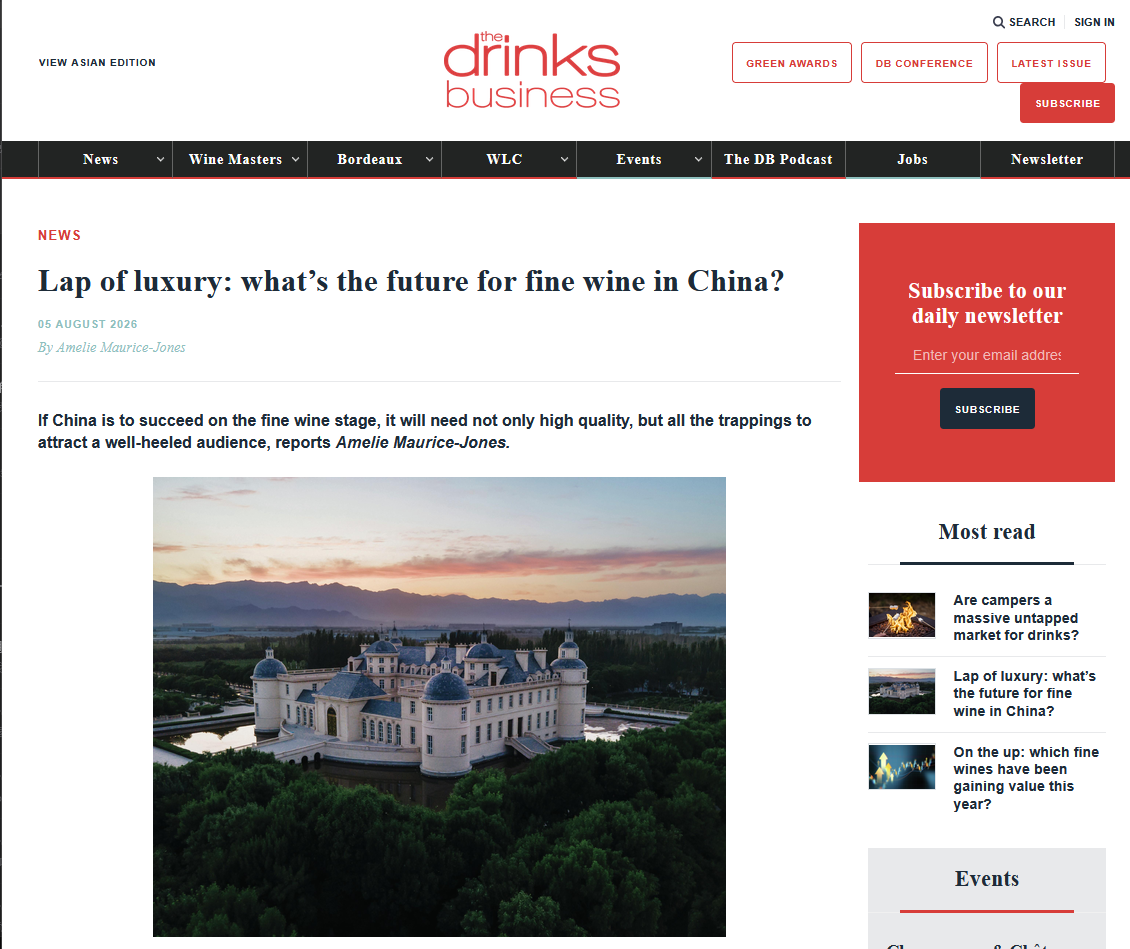
Whether it’s Runaway Cow Winery’s kooky, cow-horn modernist design, State Guest Winery’s Tang-style Chinese aesthetic, or Longting’s resort-esque ambiance between mountain and sea, the building itself serves as the most direct “visual language” of brand positioning. “Luxury is ultimately about how people feel – seen, understood and cared for,” says Christine Jia of Mahota Winery. Located Shandong province, the winery blends viticulture and tourism in its 166-hectare estate. Its parent company, Prime Group International, operates four golf clubs near Shanghai, so Mahota’s luxury customers are golfers who share an appreciation for quality and heritage. Hourriez offers two more examples of showstopper wineries: “Ningxia’s Xige Estate turns the winery itself into the destination: a striking, circle-shaped, stone-walled complex at the foot of the Helan Mountains with guest rooms, an organic restaurant and a library, turning the winery into the destination,” she says.
On the other hand, LVMH’s Ao Yun, located in the Tibetan foothills of Yunnan’s Meili Snow Mountains, does the opposite. “Its barn-like buildings across four remote villages are deliberately unshowy, and the hours needed to reach them by road become part of the luxury story: inaccessibility itself as the hospitality statement,” Hourriez explains. Her words offer an insight into the slipperiness of what luxury really is: a delicate tightrope between distance and closeness; exclusivity and access. “The most successful brands make buyers feel included, while preserving the exclusivity that makes inclusion meaningful,” Gao contends. For today’s luxury client, a simple winery tour won’t cut it. “Affluent consumers want access, participation and a sense of insider status, whether through private harvest dinners or invitation-only communities,” he continues.
Media magnetism
A bonus is that gorgeous buildings look great on social media. With China’s wine consumer base increasingly veering younger, according to IWSR research, this is paramount. Posting on platforms like Douyin and Xiaohongshu, visitors become brand ambassadors. “A livestream host with a personal connection to a winery, like Tiansai Vineyards’ Zhu Lili and her 2.1m followers, carries more weight than a critic’s score,” says Hourriez. When it comes to high-end wines, China’s Gen Z are drinking differently to their parents. They’re moving away from tannic reds to lighter styles, with drinking becoming a mode of self-expression, rather than a business obligation or simple status marker.
But when winemakers make a luxury brand, one thing matters more than anything else – a sense of exclusivity. In this way, aiming to define ‘luxury Chinese wine’ is almost a moot point, with the country’s wine regions crafting their identities from what sets them apart from one another. “Scarcity,” specifies Gao, “is about the irreplaceability of place.” Ao Yun’s high-altitude Yunnan vineyards and Silver Heights’ family-led, biodynamic approach in Ningxia create forms of luxury rooted in “terroir, difficulty and authenticity”, defined directly in how they are distinguished and different from each other.
This is echoed with lyrical charm by Landor’s executive creative director, Jamie Gandee, who says: “The more exciting future and opportunity for making brands more valuable lies in drawing directly from what each distinct wine promises and its unique terroir: Himalayan mist, Ningxia stone, desert sand, clay, vines and night skies.” According to Beijing-based Master of Wine Dr Edward Ragg high-end Chinese wine is associated with specific wineries rather than regions, be that Shanxi’s Grace Vineyard, or Emma Gao’s Silver Heights. While he expects to see Shangri-La become increasingly important, its elevation and topography mean that it’s unlikely to expand that much. Despite this, Dr Ragg expects to see emerging fine brands here in addition to the likes of Ao Yun and XiaoLing. “On a quasiBurgundian model, I expect to see small-batch, artisanal wines develop in particular up to Yunnan and neighbouring Sichuan,” he adds.
Exclusivity is at the heart of Château Changyu Moser XV’s philosophy: “We do not copy,” the producer’s brand manager Yu Song makes clear. The winery is located in the foothills of the Helan Mountains in Ningxia. The unique style of the wine is how it crafts its high-end character. “It’s based on something no-one else has in the world,” Song says. These are reportedly the smallest Cabernet Sauvignon berries in the world. A normal Cabernet berry weighs 1.5g, versus Ningxia’s 1g. “This gives a unique opportunity to grow very special bunches and transform them into unique wines,” Song explains.
Grapes and styles
Despite the the sheer geographical scale of the wine regions, some think that China’s scope to become a fine wine superpower is unified in one grape – Marselan. Michael Palij MW, who led a masterclass on China’s emerging terroirs in London earlier this year, thinks the grape, which first arrived in China’s Hebei Province at the start of the 21st century, could “become [like] Argentina’s Malbec, or Chile’s Carmenere”. This reflects comments from Domaine Franco-Chinois winemaker Zhao Desheng, who last year called Marselan a “superstar in China”. His Huaili-based winery planted 2.75 hectares of the grape in 2001, adding to evidence that it could become a selling point for the nation.
What about white wine? Recent research by Geisenheim University placed dry whites at the top of trending styles into 2027 in China, flagging opportunities for local producers to premiumise.
“Chardonnay has evolved significantly in China,” Dr Ragg says. “There is a conception, at least amongst advanced wine lovers, that fine Chinese wines may be white and are often new, oak-influenced expressions of Chardonnay.” Previously speaking to db, Palij stated: “High-quality Chardonnay is going to be from Yunnan now,” claiming that the region’s long, cool growing seasons are uniquely positioned to produce delicate pours.
But there are plenty of winemakers innovating when it comes to grape varieties outside the hard-hitters. Château Changyu Moser XV reports that its Blanc de Noir Cabernet, China’s first white Cabernet and launched 10 years ago, has been a “true winner” both globally and domestically. Xi Chen, MD of Greater China at global branding agency Dragon Rouge, also discusses how producers are experimenting with niche varieties to catch the eye of younger generations and stand out from the crowd. While Pushang pushes Marselan, Xige champions Cabernet Gernischt, Changpu Saperavi and Silk Road Petit Verdot and Malbec. Whatever the grape of choice, there’s one thing Palij sees in winemakers across the board:
“There’s a real hunger for knowledge,” he enthuses. “There’s no shortage of money and there’s no shortage of will.” Those are certainly staple ingredients in a recipe for entrepreneurial success. “In the next 10 years, I hope the rest of the world understands that Chinese winemakers are winning not because they’re cheap or because of state subsidies,” Palic adds. “They’re winning because they have great innovation, production techniques and amazing quality. They’re winning because they’re working harder.”
With passion, deep pockets and unflappable work ethic in hand, what does winning look like for Chinese winemakers? No longer, says Hourriez, is the question: “How do we sell more wine here?” but rather: “What do we want this brand to represent?”
Mahota’s Jia is the voice of the chorus when she says: “We believe that the future of Chinese luxury wine lies not in imitating Bordeaux or Napa, but in having the confidence to tell our own story. As we look ahead, we see an opportunity to redefine what ‘premium Chinese wine’ means, not as a copy of Western traditions, but as an expression of Eastern philosophy in a glass.” db